… edited by Jens Gerrit Papenburg and Holger Schulze, to be published in February 2016 by The MIT Press.
For further information see:
https://mitpress.mit.edu/books/sound-popular-culture
|
… edited by Jens Gerrit Papenburg and Holger Schulze, to be published in February 2016 by The MIT Press.
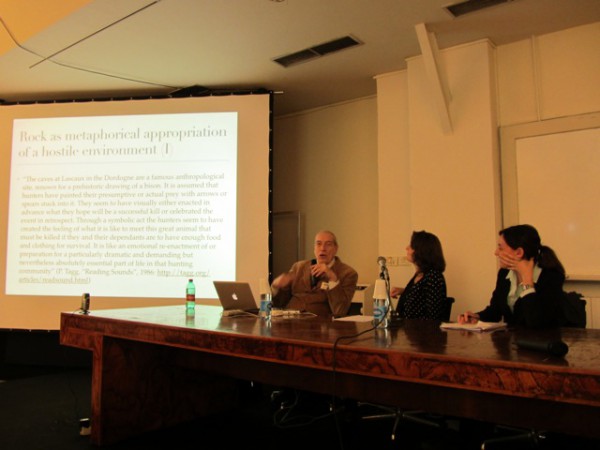
For further information see: https://mitpress.mit.edu/books/sound-popular-culture Funding prolonged by the DFG until 2016. Finally, in the sixth workshop of the research network in Milano/Italy, we discussed contributions on the most general and the most political issue of this series of six workshops: Sound Design & Acoustic Ecology. We continued our collective work on the overall structure as well as on individual chapters of the final handbook. The workshop took place at Istituto Europeo di Design Milano and it started off with our usual public symposion on Friday afternoon with Anahid Kassabian exploring the ramifications of her concept of Ubiquitous Sound regarding various methods and recent traditions of studying sound across diverse disciplines; Stefano Zorzanello then presented to us some Notes on digital sound cartography, the mash-up and enrichment of online maps with auditory, textual and other multisensory elements via crowdsourcing; inspiring thoughts by Peppino Ortoleva on the television-centered soundscape provided more provocative elements for this afternoon’s discussion. Finally Karen Bijsterveld presented the main results of her research group concerning the history of car audio: amongst them a highly differentiated selection of forms of silence (mechanical/convenient/aristocratic) she exemplified to us with a large selection of contemporary ads of automotive supplier companies since the beginning of automotive history. The day found its impressive finale in a great performance lecture by norient — i.e. Thomas Burkhalter, Simon Grab & Michael Spahr on Sonic Traces from Switzerland.
The closed workshop on saturday at the same place dealt in its first part with various aspects of sound design and acoustic ecology (in our regular format of brief 10-minute-presentations with 20-minute-discussions afterwards). Franco Fabbri, Karin Bijsterveld, Marta Garcia Quinones, Anahid Kassabian and Susanne Binas-Preisendörfer presented various perspectives on sound in the public sphere: How was the urban environment represented and performed via loudness in pop music of the 1960s? What forms of de-skilling and re-skilling takes place and took place in recent history of technology and how expert and lay listening may be bridged? How can the performativity of listening postures be analyzed? What could be the crucial elements in recent developments in the area of viral video and very short forms of entertainment? How may the diverse cultural and physiological phenomena concerning extreme loudness be analyzed in a transdisciplinary research project? Specific issues of articles in the research companion currently being developed by the network members were brought up recurrently in our discussion on this morning.
In the afternoon we discussed in three working groups the specific issues and problems adressed by the articles handed in recently; we discussed compositional matters but also questions concerning the accessibility of style and the forms of referencing. As the publication becomes ever more present, and the articles are coming in, we are preparing for the final steps of finalizing this publication in 2013. As this was the final official workshop of this funding period 2010-2013 we pointed finally at two interesting developments in the german-speaking research community and europe-wide, promoted be the network founders: (a) finally a german-speaking branch of the IASPM has been founded: IASPM-DACH with members from the network promoting this action, and (b) the European Sound Studies Association ESSA has been founded (with a concentrated effort by many members of this research network; approx. 350 new members have joined since ESSA’s announcement 3 months ago) and will present itself with its the international conference in October 2013 in Berlin, at the Sound Studies Lab.
Public Panel Discussion: Sound & The Society – A critique of the auditory design of public places 04:00 pm – 09:00 pm Friday, October 19, 2012
04:00 pm Welcome addresses by local hosts Rossella Bertolazzi (Director of the Opening words – Marta García Quiñones & Holger Schulze Part I: Critical Aspects of Sound in Public Places 06:00 pm Break – installations by students from the institute Part II: Auditory Design for the Public Sphere Part III: Sound Performance Lecture
With the fifth workshop of the research network we continued our collective work onthe overall structure as well as on individual chapters of the final handbook. The workshop took place at Leuphana-Universität Lüneburg and it started with a public symposion at the Freiraum in Lüneburg. Julian Henriques and Steve Goodman presented their views on technology and practice: Henrique with a broad and breathtaking perspective on Sound System Culture, and Goodman with an inspiring and fundamental proposal for An ontology of vibrational force. In the folloqing panel discussion Mark Butler and Paul Théberge joined and together they discussed the connecting aspects as well as the difference of their likewise approaches; it was stunning how terminologies such as nexus, apparatus, affordance or just dispositive were present in all their approaches. A future fundamentally transformed and contemporary theory of sound and musical practice could maybe then be founded basically on a complexified description of the relation between human actors and non-human (machinic, technological, instrumental) actors: following e.g. the Actor-Network-Theory (Latour) or the Affordance Theory (Gibson). A performance by Sutsche & Fello, with Cello, slowed down techno vinyls and a performative interface was finally living proof of this changed and still changing relationality between humanoids and their technological apparatuses.
The closed workshop on saturday took place at Leuphana’s Schwerpunkt audio and dealt this time in its first part with various aspects of technology in sound practices (as always in our regular format of 6 brief 10-minute-presentations). Rolf Großmann, Mark Butler, Paul Théberge, Jochen Bonz and Sarah-Indriyati Hardjowirogo presented their likewise positions and research findings on either specific cases or general reflections on the status of technology in contemporary sonic and musical cultures: How can we describe the new, algorithmic instruments of recent decades (such as the Roland TB-303) in a terminology still close to that of musicology? How can we understand and conceptualize the musical and performative practices around a DJ-set? How can we understand the highly performative instrumental practices on stage at open air concerts or open air raves/festivals that ressemble more an assemblage of tools, gadgets and hardware items than of any traditional musical instrument? How can we understand the cultural implications of the autotune-plugin? How can we make sens of new sound-generators and digital instruments for mobile tablet computers and mobile phones? All these questions brought us recurrently back to discussing the general trends in sound studies-discourses.
In the afternoon we discussed the general chapter structure, consisting of about 50 (sic 😉 ) condensed contributions from all of our network members and guests as well as from authors we invite to collaborate with us. In separate working groups we discussed selected draft articles – on Sound Practice, Broadcast Sound and on Figurations of the Modern Listener – and drew our conclusions concerning the proportion, argumentative structure and the working process of the whole volume.
A Public Symposion at Freiraum Lüneburg on the occasion of the 5th Workshop of the International Research Network funded by the German Research Foundation DFG and Leuphana Universität Lüneburg Friday May 11, 2012 4.30pm – 8pm Freiraum Lüneburg
How do new technologies shape the way we conceptualize, produce, and listen to sound? How do these new sound practices affect notions like instrument, performance, and playing? Together with the British sound researchers Steve Goodman („Sonic Warfare“, 2009) and Julian Henriques („Sonic Bodies“, 2011), we want to focus on the interrelationship between sound technologies, sound practices, and sound theories. A panel discussion with Mark Butler („Unlocking the Groove“, 2006) and Paul Théberge („Any Sound You Can Imagine“, 1997) alongside Goodman and Henriques is followed by a performance on cello, wiimote, computer, and turntables with Sutsche & Fello (Pingipung Records, Hamburg). With: Performance by Sutsche & Fello Nederlands Instituut voor Beeld en Geluid, Hilversum This one day symposium focuses on the “ears-on” experience of history in the museum. Which historical topics are most suited for a sonic approach? How can sound be staged in such a way that it makes history more easily accessible than through visual means—and which pitfalls should be prevented? Which technical tools are available beyond the audio guide and sound shower? And which possibilities for sound as an entrance into history do we have outdoors, in the form of sound walks and cell phone apps for instance? Our symposium focuses on sound in the history museum, sonic tools for the history, and sound beyond the history museum. Its is a day for museum staff members, radio makers, historians, scholars working on sound studies, and a more general audience interested in sound and history. Staging Sound in the Museum has been organized by Karin Bijsterveld and Andreas Fickers (Soundscapes of the Urban Past project, Maastricht University), Bas Agterberg (Beeld en Geluid) and Annemarie de Wildt (curator Amsterdam Museum), and is funded by NWO, the Dutch Science Foundation. Language of the day will be English With the fourth workshop of the research network we began more intensely to concentrate on working on individual chapters and the overall structure of the final handbook. The workshop took place at Humboldt-Universität zu Berlin and it started with a public symposion at the Haus der Kulturen der Welt. Under the titel Gadget & App Culture we explore the anthrtopology of the senses in everyday life with lectures and performances by Jonathan Sterne, Veit Erlmann and Antye Greie a.k.a. AGF. Jonathan Sterne started with a compressed version of his upcoming book on the cultural history of the mp3-encoding format, in which he stressed the incorporated listening model from the year 1929 that was researched on by an industry-driven strive for efficiency in transducing at Bell Laboratories, just been baught by banker J.P.Morgan at this time. In the second lecture Veit Erlmann presented his thoughts on the cultural history of the unconscious concerning sound around 1900 as he explored it in his latest publication on Reason and Resonance. Both lectures were responded by Peter Wicke respectively by Michael Bull.
Jonathan Sterne’s lecture in audio
In the center of this afternoon an auditory performance by AGF did take place that truly altered our listening mode and auditory-corporeal self-perception in the specific situation: the concetrated and logocentric mode of listening to a lecture was urged to open up to a very different, bodily grounded mode of listening to the physical beats and sound processing alogrithms applied by the artist in her latest release beatnadel.
* This time the closed workshop on saturday dealt in its first part with the regular format of 6 brief 10-minute-presentations on aspects of an anthropology of the senses – which provided (rather not surprising) an insight into the state of current sound studies and its challenges as an evolving discipline or transdiscipline. Veit Erlmann, Jens Gerrit Papenburg, Jonathan Sterne, Holger Schulze and Michael Bull presented their likewise positions and research findings on either specific cases or general reflections on methodological and disciplinary questions but also the public representation of the field called sound studies: How can we deal in sound studies research with rather non-scientific statements (in the habit of research findings) as in this scary example by Julian Treasure? How can we understand the process of conceptualizing sound in the process of mastering audio records? How can we describe the current state of sound studies and prevent the mistakes made by other researchers in developing a new research field? How can we dismantle the deeply engraved sensory models in our research cultures? And finally: How can big projects on popularizing sound & sensory art as well as sound & sensory research contribute to the development of the field? All these questions brought us recurrently back to our work on the final publication.
In the afternoon we worked together on the general chapter structure and the process of writing collectively and individually this final volume that should comprise the work and the insights of the 25 researchers at the end of three years in 2013/14 into one artifact – be it digital or be it in paperform. The first publishers have been contacted and the next step will be a more detailed proposal by the three main editors and founders of this research network. The members and guests agreed that a basic concept should give young researchers the opportunity to present their work but also to represent adaequately the international discourse and the state of research in our field in the 2010s.
* On the last day a much smaller, additional international meeting took place with researchers e.g. from Denmark and The Netherlands. At first we received the great news from Erik Jensen that a Nordic Research Network for Sound Studies (NORSOUND) has just been granted; among the eight international guests of this all-scandivian network are three members and guests of this research network namely Michael Bull, Anahid Kassabian and Holger Schulze. Our main topic at this meeting was to discuss the outline of further european perspectives for the transdisciplinary field of sound studies – concerning research projects, biennial international conferences and promoting the work and education of younger researchers in this field. (c) Photographs: Sound in Media Culture Network
Gadget & App-Culture: Sound & The Machinery of the Senses
Public Panel Discussion: Gadget & App-Culture Sound & The Machinery of the Senses
A Public Symposion
Friday October 28, 2011 Haus der Kulturen der Welt Berlin Theatersaal
How does mobile audio technology transform our perceptual techniques? How does an anthropology of sound and the senses offer new insights into our everyday life with sounds? We invited two of the most important international researchers in the field of sound studies, Jonathan Sterne and Veit Erlmann, to an afternoon of explorations: to explore the anthropology and cultural history of audile techniques – as examples of sensory technologies in populare culture. An audio performance by AGF a.k.a Antye Greie is at the center of this symposion. Michael Bull and Peter Wicke will respond to the two main lectures. An introduction into sound studies as a – rapidly expanding and developing – transdisciplinary and international field of research.
Programme:
Part I: 04:00 pm 04:15 pm Jonathan Sterne: 04:45 pm Peter Wicke:
05:30 pm Break
Part II: 06:00 pm
Part III: 06:30 pm 06:45 pm 07:15 pm
This friday sees (or better: hears) the premiere of a radio programme that has been produced in a cooperation of the research network with Deutschlandradio Kultur Berlin, the biggest german cultural radio station. It will be the first in a series of three radio features that explore current research trends, aesthetic strategies and theoretic approaches to the sound and auditory studies under the title of: Adventures in Sound: In one hour-long discussions members and guests of the international research network as well as artists, designers and musicians will present their positions, their research and production methods, their research questions and aesthetic goals – exemplified by specific and extensive The first discussion under the title Sound & the Studio has been recorded on occasion of the third workshop in London in March 2011 at the MA in Recording Arts, London College of Music. The participants were Maria Hanáček, Holger Schulze, Paul Théberge, David Toop and Simon Zagorski-Thomas (concept & production: Holger Schulze). Airdate: Friday July 8, 2011, 0:05 |
|
|||||||||||||||||||||||||||||||||||||||||||||||||||||||||||||||||||||||||||||||||||||||||||||||||||
|
Copyright © 2024 Sound in Media Culture - All Rights Reserved |
|||||||||||||||||||||||||||||||||||||||||||||||||||||||||||||||||||||||||||||||||||||||||||||||||||||